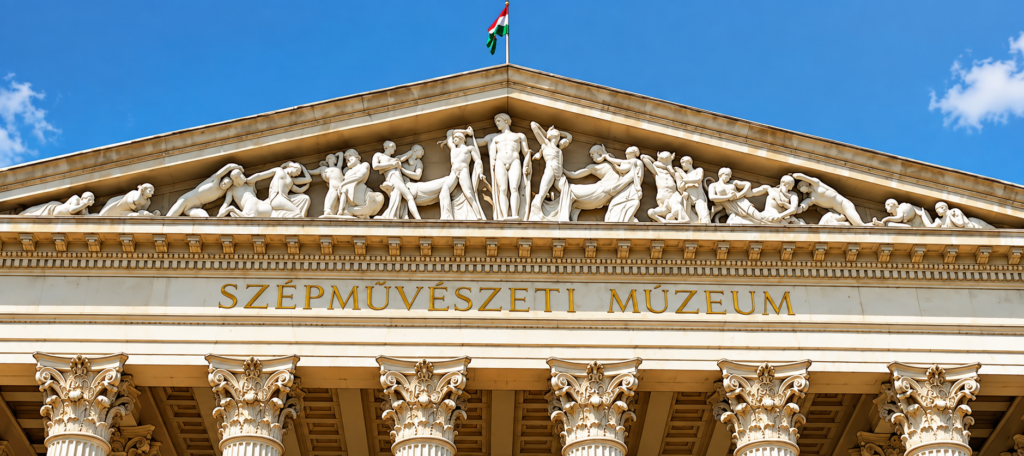
A fascinating Olympian surprise awaits in Heroes’ Square in Budapest.
The imposing Museum of Fine Arts in the Hungarian capital was founded under the legislation enacted for the celebrations of the Millennium of the Hungarian State in 1896. Designed by architects Albert Schickedanz and Fülöp Herzog, the building was constructed between 1900 and 1906 and officially inaugurated on 1 December 1906 in the presence of Emperor Franz Joseph I. It opened to the public a few days later, on 5 December.
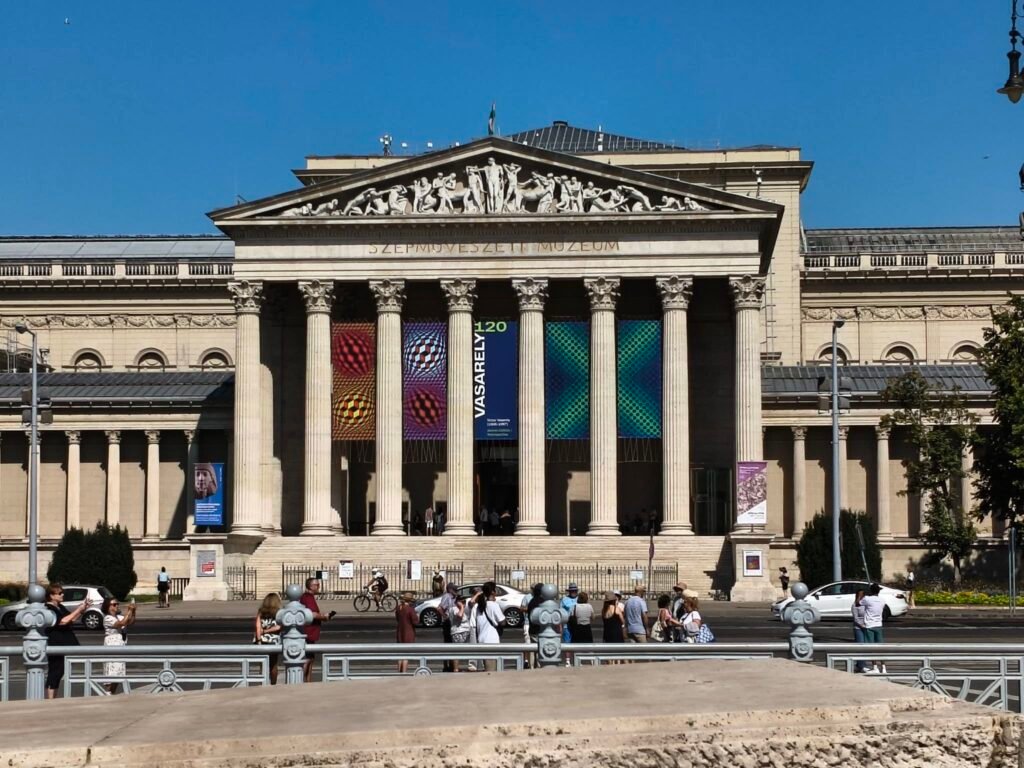
The building itself is an impressive example of historicist architecture, combining primarily Neoclassical and Neo-Renaissance elements. Its monumental façade with its great central portico, imposing staircases and halls designed in different historical styles were conceived not merely to house works of art, but also to tell, through architecture itself, a story of European civilisation.
The museum holds more than 100,000 works spanning an enormous chronological range, from ancient Egypt and Greek, Etruscan and Roman antiquity to European painting, sculpture and graphic art of the modern era. Its Egyptian collection alone comprises approximately 3,500 objects and is considered one of the most important in Central and Eastern Europe.
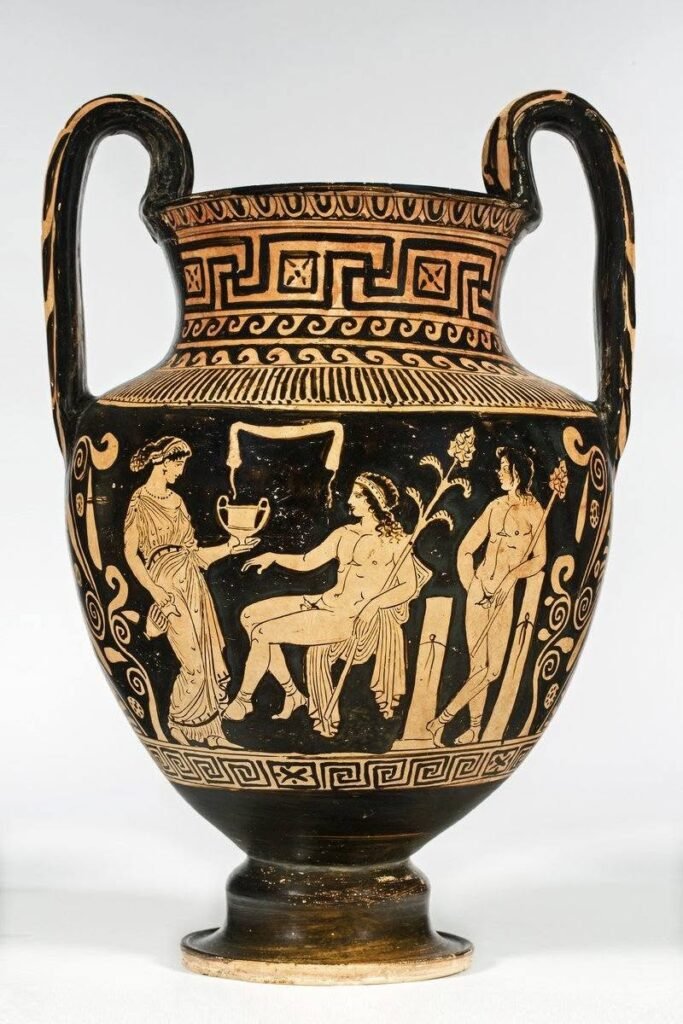
The Lucanian red-figure nestoris was created around 380–370 BC and is attributed to the Brooklyn–Budapest Painter.
The vessel belongs to the ceramic tradition of Metapontion, an important Greek centre in Lucania, where craftsmen initially adopted Athenian models before gradually developing a distinctive local style.
Its shape is a Hellenised variation of the Messapian trozzella, a vessel distinguished by its characteristic tall handles.
On the principal side, the young Dionysus is shown seated and holding a thyrsus, facing a woman who offers him a kantharos, while a satyr completes the Dionysiac scene. The columns adorned with tied ribbons probably suggest a funerary setting: the scene may symbolise the reception of the deceased woman into the circle of the god’s initiated followers.
The vessel therefore appears to have been intended from the outset as a grave offering.
Read more: https://www.mfab.hu/artworks/13332/
In the Old Masters’ Gallery, visitors encounter works of Italian, Spanish, Flemish, Dutch and German art. Among the artists represented are Raphael, with the celebrated Esterházy Madonna, Titian, Tintoretto, Giorgione, Dürer, Pieter Bruegel the Elder, Rubens, Velázquez, El Greco, Murillo and Goya. The museum’s collections also include European sculpture and an exceptionally rich body of drawings and prints.
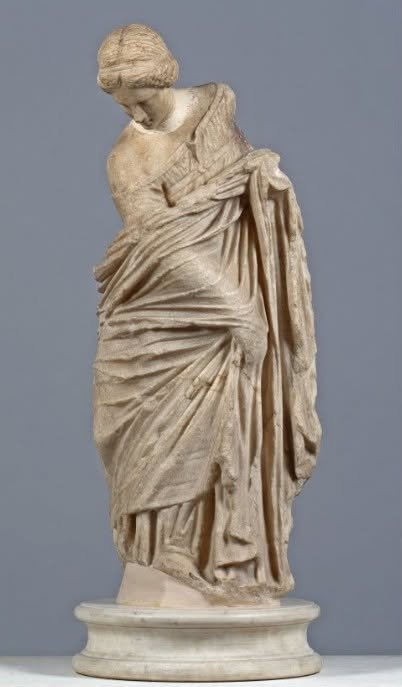
The “Budapest Dancer” is a masterful marble sculpture of the Early Hellenistic period, probably created by a Greek sculptor around 240–220 BC.
The young woman leans forward while lifting her heavy garment, creating a composition filled with restrained movement.
The opposing inclinations of the body, the delicate gestures and the richly rendered folds form a compact, pyramidal volume characteristic of the centripetal compositions of the period.
Despite its conventional name, it is by no means certain that the young woman is actually dancing. She may instead be adjusting her dress or bending down to look at her reflection in a fountain.
It is precisely this ambiguity that gives the sculpture its particular charm: it seems to capture a fleeting, private moment with remarkable naturalness. Today it is one of the best-known ancient works in the Museum of Fine Arts in Budapest.
And yet, even before we step through the entrance, something directly connected with Greece awaits us: a reconstruction using casts of the west pediment of the Temple of Zeus at Olympia has been installed in the pediment of the museum’s monumental façade.
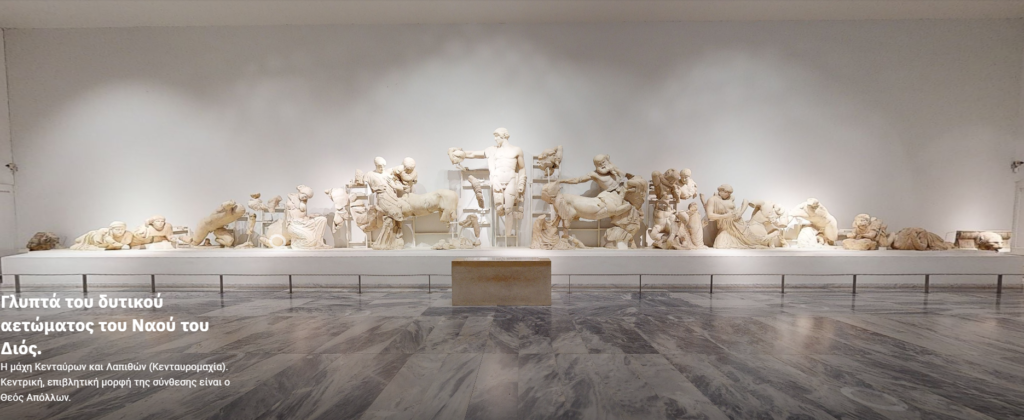
The original composition was created during the Early Classical period, around 470–456 BC, and depicts the Centauromachy at the wedding of Peirithoos and Deidameia. At its centre stands Apollo, serene and commanding amid the violent struggle between Lapiths and Centaurs, embodying order in the face of chaos.
The original sculptures from both pediments survive and are displayed in reconstructed arrangements in the Archaeological Museum of Olympia. They are not, however, presented high within the pediment of a building, in the architectural setting for which they were originally created. Based on the published information I have been able to locate, there is currently no comparable permanent display in Greece of the entire western composition installed on the façade of a Classical-style building.
Casts of complete compositions or individual figures from the Olympia pediments can also be found in other historic collections, including those in Cambridge, Münster, the Pushkin Museum in Moscow, the Ashmolean Museum in Oxford, the Louvre’s plaster-cast collection at Versailles, and collections in Berlin.
The Budapest example, however, remains exceptional. Here, the western composition is not presented merely as a group of museum exhibits. It stands high above the viewer, incorporated into the pediment of a monumental façade, allowing us to appreciate the scale and architectural function of the sculptures in an entirely different way.
How fascinating, and how sad at the same time! In Greece we possess the priceless originals, yet to see the composition high above us, set within the pediment of a Classical-style building, we have to travel all the way to Budapest.
I owe this valuable piece of information to my dear friend Thanasis Tzoitis. I was unaware of it, despite having visited the Hungarian capital myself. Yet another reminder that every city keeps secrets waiting to be discovered on a second, more attentive look…
See here the original composition:
See here the pediment on the façade of the Museum of Fine Arts in Budapest